

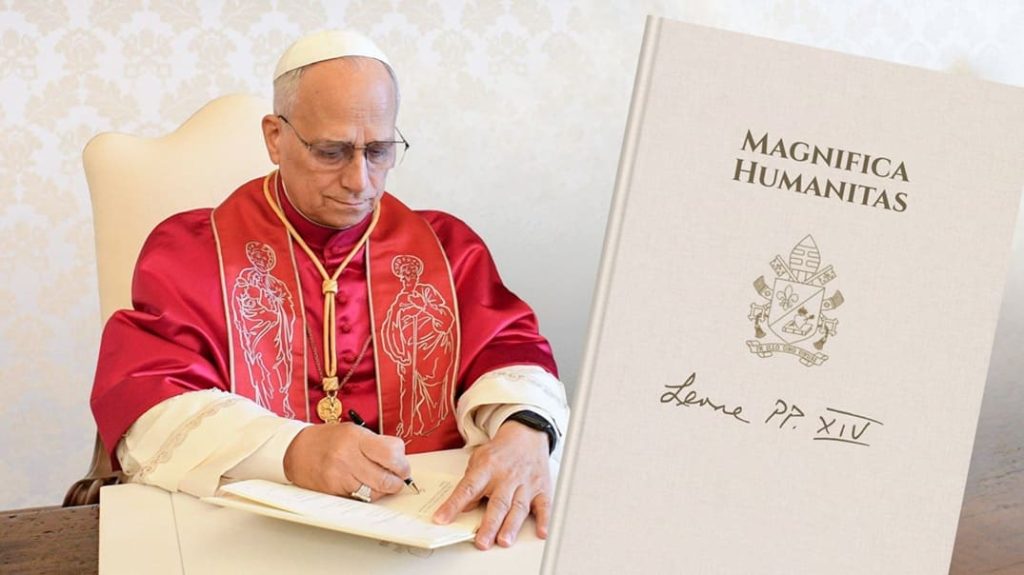
Encyclical Letter Magnifica Humanitas Of His Holiness Pope Leo XIV
On Safeguarding The Human Person In The Time Of Artificial Intelligence
VATICAN CITY — Pope Leo XIV has officially released his highly anticipated first papal encyclical, titled Magnifica Humanitas (“Magnificent Humanity”). The historic document addresses the rapid, sweeping advancement of artificial intelligence and its profound impact on human dignity, labor, and global conflict.
In a deeply symbolic move, the Holy Father officially signed the text on May 15, directly marking the 135th anniversary of Rerum Novarum—the landmark 1891 encyclical by Pope Leo XIII that established modern Catholic social teaching during the height of the Industrial Revolution.
A New “Industrial Revolution.”
By aligning the release with the anniversary of Rerum Novarum, Pope Leo XIV draws a direct parallel between the socioeconomic upheavals of the 19th-century machine age and the modern digital era. Where Leo XIII fought for workers’ rights and human dignity against unregulated industrial capitalism, Leo XIV warns against a new era of exploitation driven by data monopolies and algorithmic optimization.
In the text, the Pope emphasizes that humanity is undergoing a massive “change of epoch,” cautioning that a culture focused purely on relentless technological efficiency risks treating the human person as “a project to be optimized rather than as a creature called to relationship and to communion.”
”For an algorithm, error is something that must be corrected; for a person, it can be the beginning of a profound change.”
— Pope Leo XIV, Magnifica Humanitas
Core Pillars of the Encyclical
The document tackles several pressing global challenges across its chapters:
The Illusion of Efficiency: The Pope insists that fundamental human dignity does not depend on a person’s economic output or digital capacity, calling out the temptation to reduce human life to mere data points.
Corporate Power & Regulation: Leo XIV strongly criticizes the massive concentration of wealth and influence in the hands of a few private tech monopolies. He stresses that “abstract ethics” are not enough, calling on world leaders to implement robust legal frameworks and independent oversight.
The “Normalization” of War: In some of the document’s sharpest passages, the Pope decries how AI-driven weaponry and automated battlefield decisions are desensitizing the world to the real human cost of violence. He explicitly states that traditional “just war” theories are increasingly outdated in an age of automated warfare, pleading instead for a return to aggressive diplomacy and dialogue.
An Unprecedented Launch
Highlighting the Vatican’s desire to engage directly with the architects of the digital age, the official presentation of the encyclical featured an unexpected guest: Christopher Olah, the co-founder of the prominent US artificial intelligence safety firm Anthropic.
Olah welcomed the Pope’s moral critique, acknowledging that the threat of AI displacing human labor at a massive scale requires serious, external moral voices that “incentives cannot bend.”
With Magnifica Humanitas, Pope Leo XIV has firmly set the benchmark for how the global Church intends to navigate, critique, and humanize the rapidly evolving digital landscape.
Make Love Go Viral

